How does laser hair removal work?
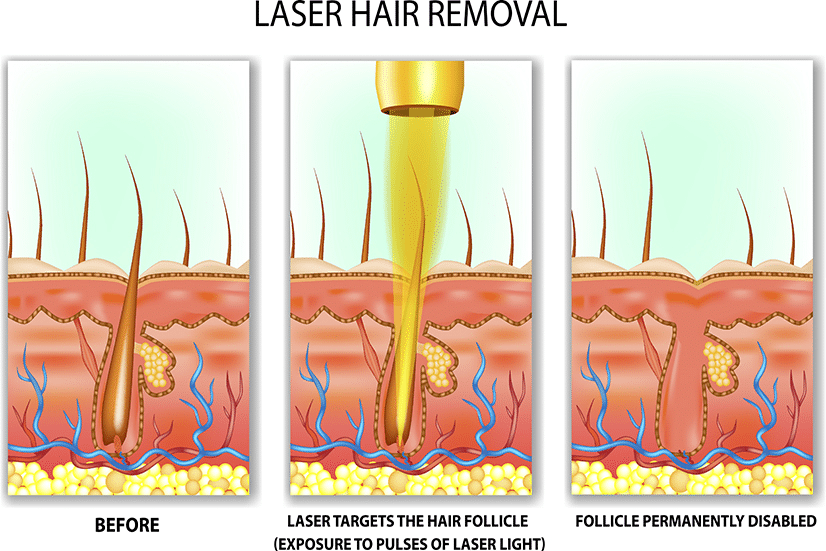
Laser hair removal uses laser technology and targets the melanin in the hair follicle. By using a laser emitter, a laser breaks down the melanin and destroys the hair follicle, the hair will not grow back again. In the market, there are 1064nm long pulse laser, 808nm diode laser, and Intense pulse light for hair removal. The principle of Laser hair removal works is due to the light of the laser beam can be converted to heat.
The light is targeted at the pigment (melanin) in the hair. The dark pigment absorbs the light and converts it to heat.
The heat then affects the hair follicles to prevent hair growth. To destroy a hair follicle, the bulb of the hair follicle where the blood supplies the hair with oxygen to grow needs to be destroyed as well as the stem cells which are responsible for hair regeneration. To be able to do this, a temperature of about 70 degrees needs to be reached.
Once the hair follicle has been destroyed, it is almost impossible for future growth to take place. 80-95% of hair is removed during the treatment, although this can depend on the patient’s age and the area being treated. It is worth noting that in 10% of cases, the treatment may not work, even if patients show a good indication for treatment.
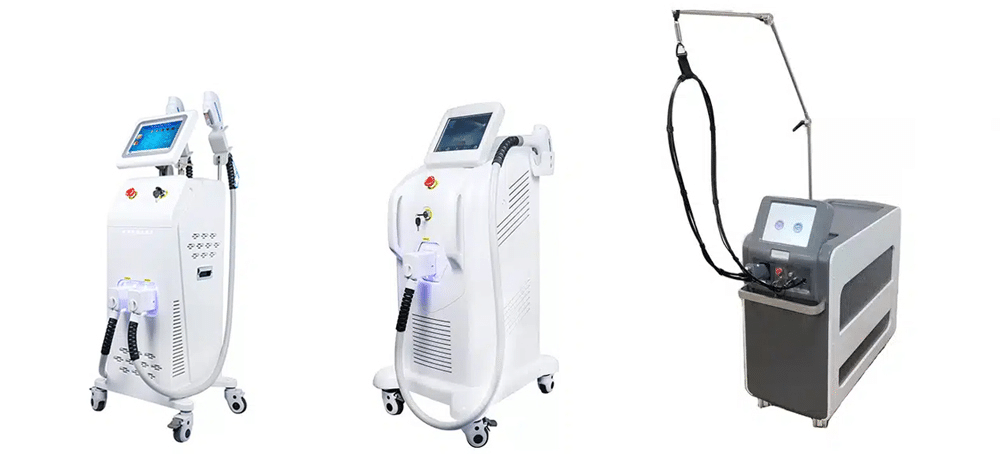
How To Select The Best Laser Hair Removal Machines?
How to select the best laser hair removal machines? A good laser hair removal machine could help boost your spa and salon business. However, there are many options in the…
How Long Does Laser Hair Removal Take?
The Science Behind Laser Hair Removal: Selective Photothermolysis
At the heart of every laser hair removal treatment is a scientific principle called selective photothermolysis, first described by dermatologists Anderson and Parrish in 1983. Let’s break the term down:
- Selective — The laser targets a specific structure (the chromophore) without damaging surrounding tissue. In hair removal, that target is melanin, the dark pigment in your hair.
- Photo — Light. The laser emits light at a carefully chosen wavelength that melanin absorbs strongly.
- Thermolysis — Heat destruction. The absorbed light energy converts to heat, which destroys the target.
In simple terms: the laser light finds the dark pigment in your hair, heats it up to roughly 70°C (158°F), and the heat travels down the hair shaft to destroy the follicle.
How It Works — Step by Step
- The laser emits a specific wavelength of light — typically 755nm, 808nm, or 1064nm, chosen because melanin absorbs these wavelengths far more than surrounding skin does.
- Melanin in the hair shaft absorbs the light — Dark, coarse hair absorbs the most energy. This is why laser works best on dark hair.
- Light energy converts to heat — Within milliseconds, the absorbed light energy transforms into thermal energy.
- Heat travels down the hair shaft — The heat conducts through the hair into the follicle bulb and the bulge region, where stem cells responsible for hair regeneration are located.
- The follicle is thermally destroyed — At ~70°C, proteins denature and cells in the dermal papilla and bulge are irreversibly damaged.
- The follicle can no longer produce terminal hair — Without functional stem cells and blood supply, the follicle either dies or produces only fine vellus hair.
Why Cooling Technology Matters
Your skin also contains melanin, especially in darker skin tones. If the laser heats surface melanin without protection, it can cause burns. Modern laser hair removal machines use built-in cooling — sapphire contact tips (0-5°C), cryogen spray, or chilled gel — to protect the epidermis while allowing laser energy to pass through to the deeper follicle. This combination of right wavelength + right pulse duration + active cooling is what makes modern laser hair removal safe across all skin types.
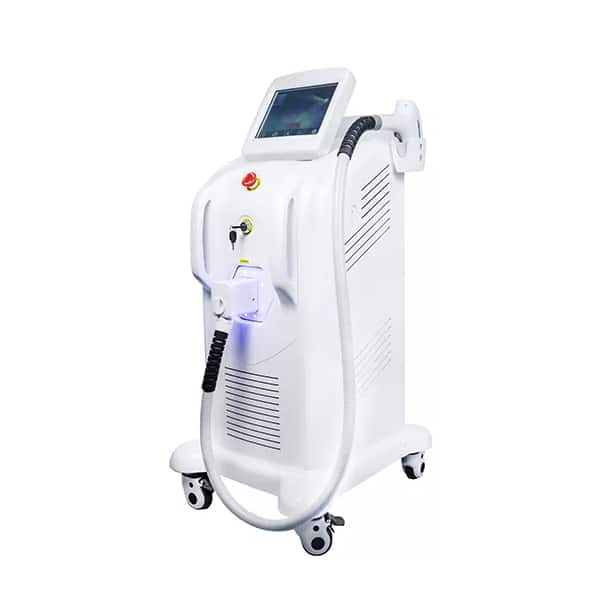
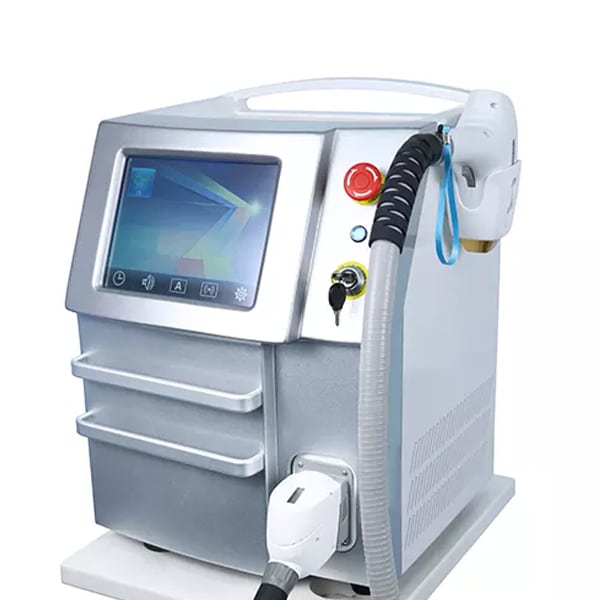
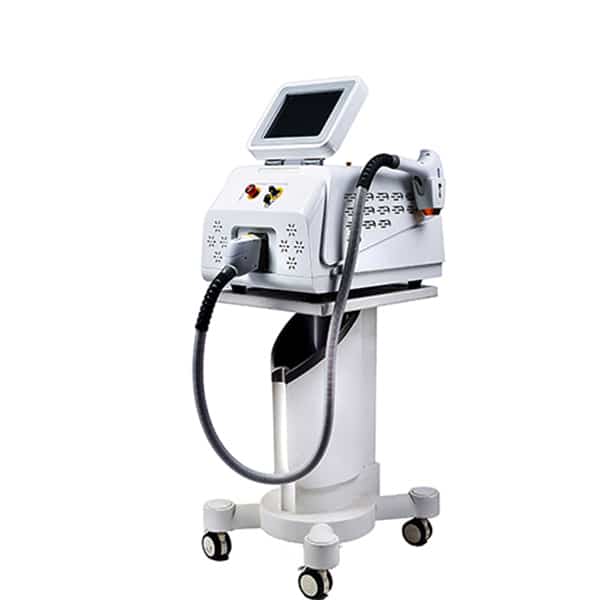
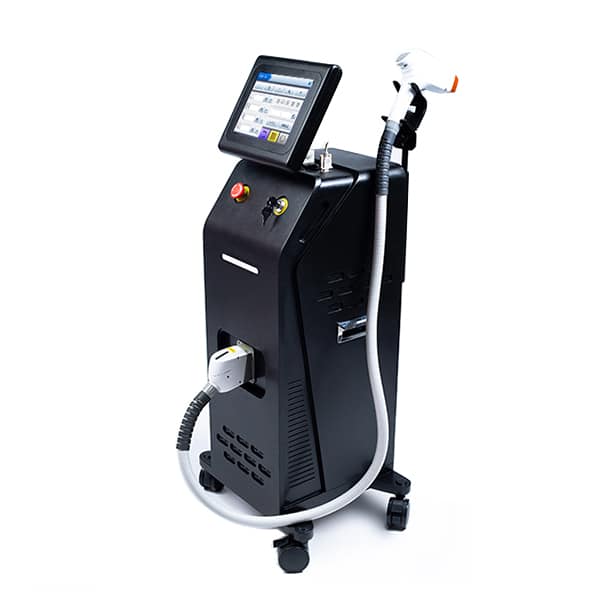
Diode laser hair removal principle
Diode laser for hair removal is using the 808nm wavelength.
In diode laser, the hair removal principle of selective photothermolysis applies where the chromophore is melanin in the hair shaft itself and the bulge. However, the same chromophore can be found in skin pigment. Some parts of the body, such as underarms or the pubic area, are more pigmented.
IPL laser hair removal principle
IPL is an intense pulse light and uses 640nm-1200nm for hair removal.
For IPL, The light that comes out of an IPL device is absorbed by the pigment in the hair, causing a buildup of energy which turns to heat (think of a black T-shirt on a sunny day). The heat travels down the hair and disables or destroys the cells that make new ones.
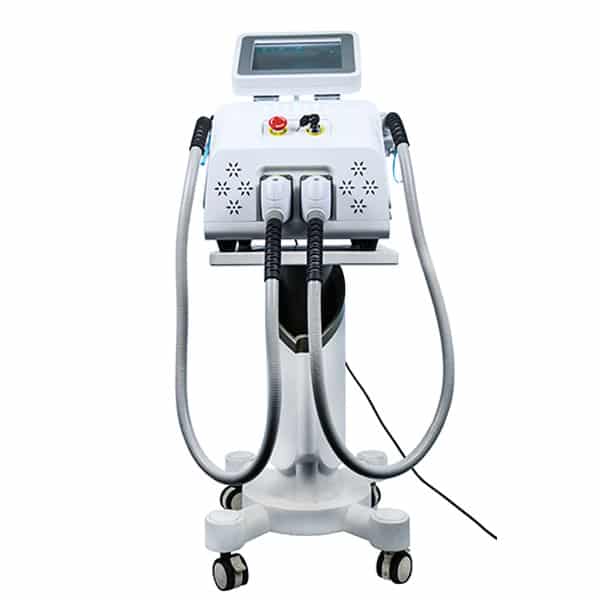
IPL Hair Removal Machine
Long pulse ND YAG Laser hair removal principle
Long pulse laser using the 1064nm wavelength.
It works on the principle of selective photothermolysis—the laser damages the hair follicle without damaging the skin. Shorter Nd: YAG pulses are also effective in hair reduction while maintaining better comfort for the patient.
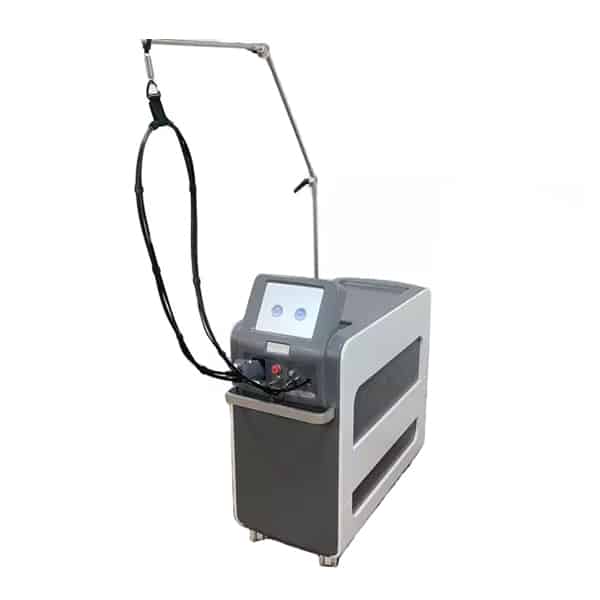
Long Pulse ND YAG Laser Machine
Watching the video for the laser hair removal treatment.
Understanding the hair growth cycle of the hair
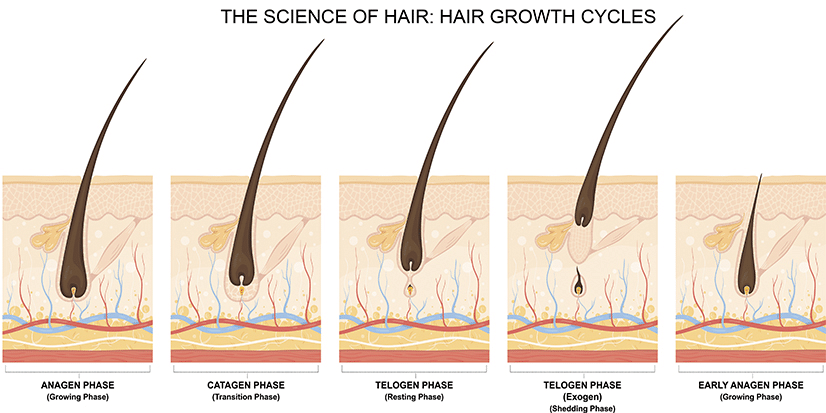
We should know that 1 session of laser treatment cannot remove all the hair because the hair has a growth cycle. Hair growth has 3 different stages of growth and not all hairs grow at the same time. This is the reason that why you can observe sometimes when you wax about a week later there is hair starting to grow again. Usually, these are not the same hairs you waxed a week ago, they would be hairs from another follicle that were at a different stage of growth.
Read More:https://vivahifu.com/how-long-does-laser-hair-removal-take
Anagen
This is the 1st phase of the hair growth cycle. It is the active growth phase. At this stage, the bottom of the hair follicle (the bulb) is attached to the dermis and its blood supply through the dermal papilla. This is the best period to remove the hair.
Catagen
This is the 2nd phase of the hair growth cycle. the transition phase. The hair follicle begins to die and enters the catagen phase
Telogen
the resting phase. In this phase, the remains of the hair bulb are inactive and the attached hair easily falls out.
Why Multiple Sessions Are Essential
Laser only works on hairs in the anagen (growth) phase — the only stage where the hair is rich in melanin and connected to the blood supply. At any given time, only about 15-20% of your hair follicles are in the anagen phase. The rest are transitioning (catagen) or resting (telogen) and immune to the laser.
This is why you need multiple sessions — not because the laser “missed,” but because you need to catch each follicle as it enters anagen:
| Body Area | % Hairs in Anagen | Recommended Interval |
|---|---|---|
| Face / Upper Lip / Chin | ~30-40% | 4-5 weeks |
| Underarms | ~30% | 5-6 weeks |
| Bikini Line | ~30% | 5-6 weeks |
| Arms | ~20% | 6-8 weeks |
| Legs | ~20% | 8-10 weeks |
| Back / Chest | ~15-20% | 8-10 weeks |
Most people need 6-8 sessions spaced 4-10 weeks apart to catch the majority of follicles as they cycle into anagen. After completing the full course, 80-90% hair reduction is realistic — with 1-2 annual maintenance sessions afterward.
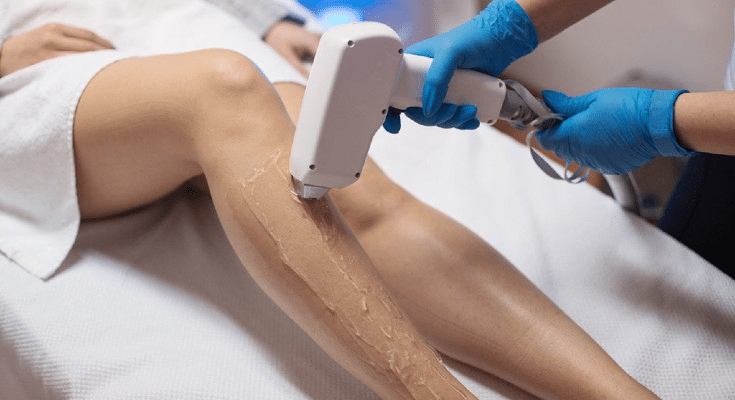
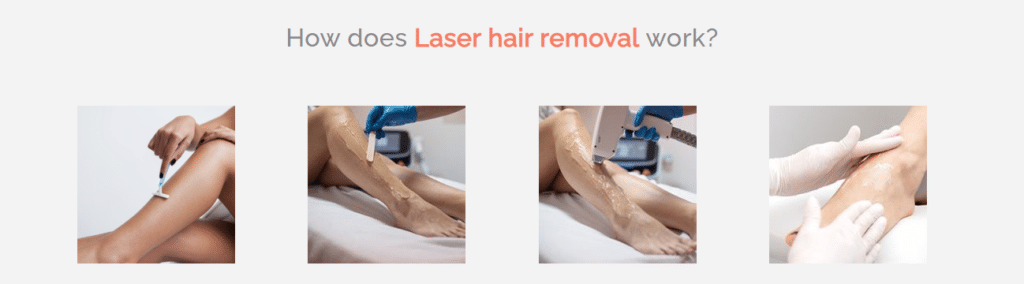
How to use a laser hair removal machine?
- Shaving: You should shave the target area 1 or 2 days before the hair removal treatment
- Apply the cooling gel: Apply laser conductor gel to ensure effective penetration of the laser beam
- Hair Removal: The hair removal process will begin. Comfortable treatment with no pain. Generally 20 – 30 mins depending on area.
- Laser aftercare hydration: Laser aftercare will be applied to minimize skin irritation. Repeat sessions until the hair is completely removed.
Before Your Session: Complete Preparation Checklist
4 Weeks Before
- Stop waxing, plucking, threading, and epilating. The laser needs the hair root intact. Shaving is fine — it leaves the root in place.
- Stop tanning — sun exposure and artificial tanning increase melanin near the skin surface, raising burn risk.
- Avoid chemical peels and laser resurfacing on the treatment area.
2 Weeks Before
- Stop self-tanner. Gradual tanning lotions leave pigment that competes with hair follicles for laser absorption.
- If on photosensitizing medications (certain antibiotics, Accutane, St. John’s Wort), consult your doctor.
2-3 Days Before
- Stop retinoids, AHAs, BHAs, glycolic acid, and strong exfoliants — they thin the skin and increase sensitivity.
24 Hours Before
- Shave the treatment area. Shaving removes surface hair (which can burn) but leaves the root intact.
Day of Treatment
- Clean skin only — no lotions, deodorant, perfume, makeup, or creams on the treatment area.
- Wear loose, comfortable clothing.
What Happens During a Laser Hair Removal Session
- Consultation and skin assessment. Your provider evaluates your Fitzpatrick skin type, hair characteristics, and medical history to determine the safest laser and settings for you.
- Protective eyewear. Both you and your provider wear opaque goggles.
- Area preparation. The skin is cleaned and a cooling gel is applied to conduct laser light and protect surface skin.
- Test pulse. A small test patch checks your skin’s reaction before the full treatment.
- Laser application. The handpiece delivers short pulses of light. Most people describe the sensation as a rubber band snapping against the skin with brief heat. Modern cooling tips make it surprisingly comfortable. A faint burning smell is normal — it’s surface hair vaporizing, not skin.
- Post-treatment care. Cooling aloe vera gel or post-laser cream is applied to calm the skin.
Typical session times: Upper lip / chin ~5 min | Underarms ~10 min | Bikini line ~15-20 min | Full face ~20-30 min | Half legs ~30 min | Full back ~45-60 min.
Aftercare: Do’s and Don’ts
First 24-48 Hours
- DO apply cool compresses or aloe vera for redness — a mild sunburn sensation is normal.
- DO wear loose clothing to avoid friction.
- DON’T take hot showers, use saunas, steam rooms, hot tubs, or pools.
- DON’T do intense exercise — sweat irritates treated follicles.
- DON’T apply deodorant if underarms were treated.
First Week
- DO apply SPF 30-50+ daily — your skin is extra vulnerable to UV.
- DO gently exfoliate around day 5-7 — this helps treated hairs shed naturally.
- DON’T pick or pull at shedding hairs.
- DON’T wax, pluck, or thread (shaving is OK).
Side Effects and Risks
Common & Temporary
- Redness and mild swelling around follicles — fades within 24-48 hours.
- Warmth or tingling that subsides within hours.
- Hair shedding over 1-3 weeks — looks like growth but is actually treated hairs falling out (a positive sign).
Less Common (Usually Temporary)
- Hyperpigmentation (dark spots) or hypopigmentation (light spots) — more likely with sun exposure or darker skin.
- Mild acne-like breakouts as follicles react to heat.
- Paradoxical hypertrichosis — rare increase in fine hair near treated area, more common on face.
Rare (Seek Medical Attention)
- Blisters, burns, or scarring — typically from improper settings or unqualified operators.
- Infection — rare with proper aftercare.
How to minimize risk: Choose a qualified provider, be honest about medications and sun exposure, do a patch test, and follow pre/post-care instructions strictly.
Who Is a Good Candidate?
Ideal: Dark, coarse hair on light to medium skin — high contrast gives best results. Those tired of regular shaving/waxing and willing to commit to 6-8 sessions.
Can be treated: Darker skin (Fitzpatrick V-VI) with Nd:YAG 1064nm lasers. Lighter/finer hair — needs more sessions, results less dramatic.
Should avoid: Pregnancy/breastfeeding, photosensitizing medications, active skin infections, keloid scarring tendency, history of skin cancer in area, recent tan/sunburn, tattoos in area, very light blonde/red/gray/white hair.
Results Timeline
| Session | Reduction | What to Expect |
|---|---|---|
| 1 | 10-25% | Hairs shed over 2-3 weeks |
| 2-3 | 30-50% | Regrowth finer, slower |
| 4-6 | 60-80% | Most areas significantly reduced |
| 6-8 | 80-90% | Near-complete clearance |
| Maintenance | — | 1-2 touch-ups per year |
Peak results appear 1-2 months after your final session. Results last 6-18+ months depending on age, hormones, and body area.
How Much Does Laser Hair Removal Cost?
| Area | Per Session (USD) | Full Course (6-8 sessions) |
|---|---|---|
| Upper Lip | $75-150 | $450-1,200 |
| Underarms | $150-250 | $900-2,000 |
| Bikini Line | $150-300 | $900-2,400 |
| Full Face | $250-500 | $1,500-4,000 |
| Half Legs | $300-500 | $1,800-4,000 |
| Full Back | $400-700 | $2,400-5,600 |
Tip: Buy packages for 15-30% off. Watch for fall/winter promotions. Factor in 1-2 annual maintenance sessions.
Frequently Asked Questions
Is laser hair removal permanent?
Laser provides long-term reduction (80-90% after a full course) but is not always 100% permanent. Regrowth is typically finer and sparser. The FDA classifies it as “permanent hair reduction.” Maintenance sessions (1-2/year) sustain results.
How many sessions do I need?
6-8 sessions, spaced 4-10 weeks apart depending on body area. Facial hair needs shorter intervals (4-5 weeks); body hair needs longer (8-10 weeks).
Does laser hair removal hurt?
Most describe it as a rubber band snap with brief heat — typically 3-6 on a 0-10 scale. Modern cooling tips reduce discomfort significantly, and numbing cream is an option for sensitive areas.
Can laser work on dark skin?
Yes — Nd:YAG lasers (1064nm) are specifically designed for darker skin (Fitzpatrick V-VI). Always choose a provider with proven experience treating your skin type.
Can laser work on blonde, red, or gray hair?
No — these hair types lack eumelanin (the dark pigment that absorbs laser energy). Electrolysis is the FDA-approved alternative for light-colored hair.
What is the difference between IPL and laser?
IPL uses broad-spectrum light (640-1200nm), not a true laser. Lasers emit a single wavelength for greater precision and effectiveness. IPL is cheaper per session but requires more sessions for comparable results.
Is at-home laser hair removal effective?
Home devices use much lower energy (3-10 J/cm² vs. 20-50+ J/cm² professional) and provide “reduction” rather than “removal.” They require weekly use for 8-12 weeks. Professional treatments offer dramatically better results.
How long do results last?
6-18+ months after completing a full course. Longevity depends on age, hormones, body area, and underlying conditions. Annual maintenance extends results.
Key Takeaways
- Selective photothermolysis — light targets melanin, converts to heat, destroys the follicle.
- 6-8 sessions needed — only 15-20% of hairs are treatable at any time.
- 80-90% reduction is realistic; 1-2 annual maintenance sessions sustain results.
- Technology matters — diode (808nm) for light-medium skin, Nd:YAG (1064nm) for dark skin.
- Preparation and aftercare are critical — no tanning, no waxing, strict sun protection.
- Choose your provider wisely — operator skill and equipment quality determine safety and results.
References
- Anderson RR, Parrish JA. “Selective photothermolysis: precise microsurgery by selective absorption of pulsed radiation.” Science. 1983;220(4596):524-527.
- American Academy of Dermatology Association. “Laser Hair Removal: Overview.” aad.org
- Mayo Clinic. “Laser Hair Removal.” mayoclinic.org
- American Society for Laser Medicine & Surgery (ASLMS). “Laser Hair Removal.” aslms.org
- Dierickx CC et al. “Permanent hair removal by normal-mode ruby laser.” Arch Dermatol. 1998;134(7):837-842.
Article last updated: August 2026. Written by the VIVA Editorial Team. VIVA Concept Technology is a professional beauty machine manufacturer with over 12 years of experience in laser and HIFU technology. This article is for educational purposes only and does not constitute medical advice.