IPL vs Laser: — Which Cosmetic Treatment Is Right for You?
If you’ve spent any time looking into cosmetic treatments, you’ve bumped into the same question over and over: IPL or laser — which one actually works better?
The short answer? It depends entirely on your skin, your goals, and how much permanence you’re after. But most articles you’ll find online gloss over the details that actually matter when you’re making a real decision with real money.
This guide walks through the differences honestly — no marketing fluff, no oversimplified charts. Just what the technology can and can’t do, broken down in a way that actually helps you choose.
IPL vs Laser at a Glance
If you only have thirty seconds, here is the side-by-side breakdown. But stick around — some of these rows deserve more explanation than a table cell can give them.
|
IPL |
Laser |
|
|
Light type |
Broad spectrum (many wavelengths) |
Single wavelength (monochromatic) |
|
Penetration |
Shallow — upper dermis only |
Deep — reaches hair bulb and deep dermis |
|
Precision |
Lower — scattered light |
High — focused beam on target only |
|
Best skin types |
Fitzpatrick I–III |
Fitzpatrick I–VI (laser-dependent) |
|
Pain level |
Mild warmth or light flick |
Rubber band snap; cooling mitigates |
|
Sessions needed |
8–12 for hair removal |
6–8 for hair removal |
|
Session interval |
2–4 weeks |
4–8 weeks |
|
Downtime |
None (mild redness, hours) |
0–3 days (redness, possible swelling) |
|
Cost per session |
$100–$300 |
$200–$600 |
|
Best for |
Surface pigment, mild redness, hair reduction on light skin |
Deep wrinkles, scars, permanent hair removal, all skin types |
What are IPL and LASER?
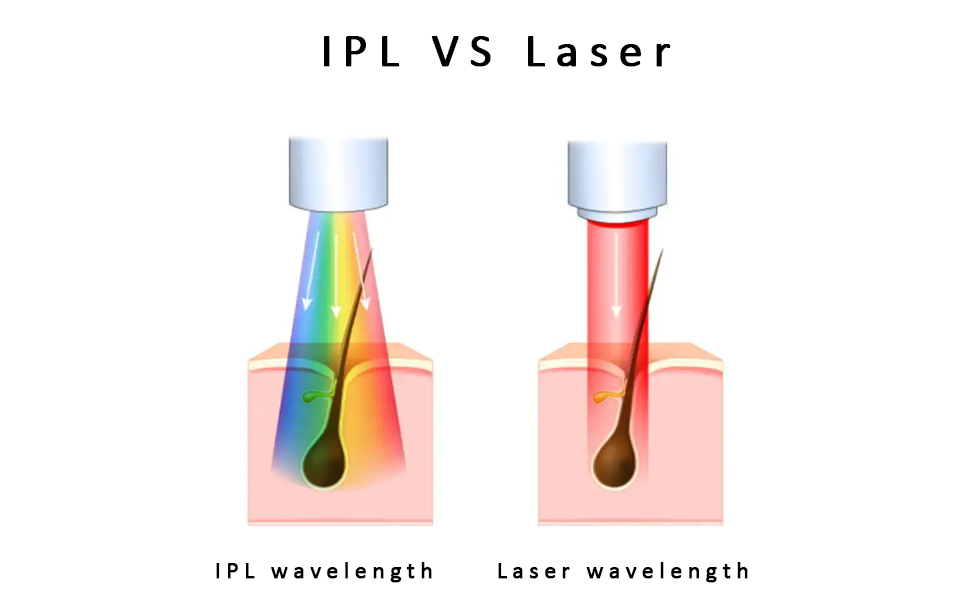
IPL (Intense Pulsed Light) and LASER (Light Amplification by Stimulated Emission of Radiation) are both popular cosmetic procedures used to improve the appearance of skin. Think of it this way — IPL is like a floodlight that illuminates an entire room. A laser is like a penlight aimed at a single spot on the wall. Both produce light. Both can treat skin. But the way that light behaves inside your skin is fundamentally different.
IPL — Intense Pulsed Light — fires a broad spectrum of wavelengths, typically from about 500 to 1,200 nanometers, all at once. Because it’s a wide band of light, it scatters more when it hits your skin. Some of it gets absorbed by melanin. Some gets absorbed by blood vessels. Some just diffuses into surrounding tissue. That’s why IPL can treat several things at once — redness, brown spots, mild hair — but it doesn’t go very deep and it isn’t very selective about what it hits.
Laser emits a single, specific wavelength — say 808 nanometers for a diode laser, or 1,064 for an Nd:YAG. Because all the energy is concentrated at one wavelength, it penetrates deeper and targets one specific thing: melanin in the hair, hemoglobin in a blood vessel, or water in scar tissue. The surrounding skin stays cooler. That’s the whole idea behind selective photothermolysis, the principle Anderson and Parrish first described back in 1983 that all modern light-based treatments are built on.
Both IPL and LASER are safe and effective treatments for improving the appearance of skin. However, there are some differences between the two procedures. IPL is typically less expensive than LASER, but it may require more treatments to achieve desired results. LASER is usually more expensive than IPL, but it typically requires fewer treatments to achieve desired results.
So when someone says ‘IPL is just a weaker laser,’ they’re wrong. It’s not weaker — it’s a completely different category of light. The question isn’t which one is better in the abstract. The question is which one matches what you’re actually trying to fix.
How IPL Works on Hair and Skin?
Intense Pulsed Light (IPL) is a popular hair removal method that uses broad-spectrum light to target and disable hair follicles. IPL use the principle of Selective Photothermolysis. IPL emits multiple wavelengths of light that are absorbed by melanin (the pigment in hair). The light energy converts to heat, damaging the hair follicle while sparing the surrounding skin.
When IPL light hits your skin, the melanin in your hair absorbs those wavelengths and converts them into heat. That heat travels down the hair shaft into the follicle, damaging the cells responsible for hair growth. Broadly speaking, it’s the same mechanism as laser — but the heat is less concentrated, so the damage to the follicle is less complete.
IPL can also target hemoglobin (the red in blood vessels) and excess melanin (brown spots) closer to the skin’s surface. That’s why a single IPL session can simultaneously lighten sun spots, reduce facial redness, and thin out hair — if your skin is light enough to tolerate the scattered energy.
Here’s what matters most: IPL needs contrast.
The melanin in your hair has to be significantly darker than the melanin in your skin. If you have dark hair and fair skin, IPL can work well. If your hair is blonde, red, grey, or white — the melanin simply isn’t there to absorb enough light. You could do twenty sessions and see almost no change.
Similarly, if your skin has more melanin — Fitzpatrick IV, V, or VI — that broad-spectrum light gets absorbed by your skin before it can reach the follicle. The result isn’t just ineffective treatment. It’s a burn.
It’s important to understand that hair grows in cycles, and light-based treatments only work on follicles in the anagen (active growth) phase — when hair contains the most melanin. Since not all hairs are in this phase at the same time, multiple sessions (usually 6-8 treatments) are needed for optimal results.
How Laser Works on Hair and Skin?
Laser hair removal uses a single, concentrated wavelength that passes through the epidermis with minimal scattering and delivers energy precisely to the melanin in the hair follicle. Because the beam is focused — not diffuse like IPL — more energy reaches the follicle, less leaks into surrounding tissue, and the damage to the follicle is more complete.
Not all lasers are the same, though. Different wavelengths suit different skin tones. Here’s the quick breakdown:
This light is absorbed by melanin (the pigment in hair), converting to heat and damaging the follicle. The surrounding skin remains unharmed due to the laser’s precision.
There are several laser types which are effective for hair removal:
- Alexandrite (755 nm) – Best for light to olive skin.
2. Diode (800-810 nm) – Effective for most skin types, including darker tones.
3. Nd:YAG (1064 nm) – Safest for dark skin (melanin bypasses epidermis).
4. Ruby (694 nm) – Older, less common; best for fine, light hair.
|
Laser Type |
Wavelength |
Best Skin Types |
Hair Colors It Works On |
|
Alexandrite |
755 nm |
I–III |
Dark, coarse |
|
Diode |
808 nm |
I–IV |
Dark, medium |
|
Nd:YAG |
1064 nm |
IV–VI |
All dark shades |
|
Ruby |
694 nm |
I–II |
Fine, light |
The 808nm diode is the workhorse of most clinics — it handles about 80% of clients safely. The 1064nm Nd:YAG is what you want if your skin is darker, because the longer wavelength bypasses epidermal melanin almost entirely. Alexandrite is fast and effective on very light skin, but using it on tanned or darker skin is asking for trouble.
When to Use IPL
IPL (intense pulsed light) therapy is a cosmetic skin treatment that uses pulses of light to improve the appearance of the skin. IPL is often used to treat sun damage, age spots, and other forms of hyperpigmentation. It can also be used to treat wrinkles, fine lines, and other signs of aging.
IPL is most effective when used on patients with light to medium skin tones. The procedure is not recommended for those with dark skin tones, as it can cause further pigmentary changes. IPL should also be avoided in patients who are pregnant or breastfeeding.
The decision to use IPL or laser therapy should be made by a qualified aesthetician or dermatologist.
When to Use Laser
Laser therapy is a cosmetic procedure that uses a concentrated beam of light to remove unwanted hair, treat acne, and reduce the appearance of wrinkles, sun spots, and other skin imperfections. IPL (intense pulsed light) therapy is a similar procedure that uses a broad-spectrum light source to achieve the same results. So, which one is right for you?
Here are some factors to consider when deciding between laser and IPL therapy:
Area of treatment: Laser therapy is best suited for small, specific areas, such as the upper lip or chin. IPL therapy can be used on larger areas, such as the face, chest, or back.
Skin type: Laser therapy is safe for all skin types. However, people with dark skin may experience more side effects, such as hyperpigmentation. IPL therapy is not recommended for people with dark skin because it can cause burns and blistering.
Hair color: Laser therapy is most effective on dark hair. If you have light hair, laser therapy may not be the best option. IPL therapy can be used on all hair colors.
Budget: Laser therapy is typically more expensive than IPL therapy because it requires specialized equipment.
Why Skin Tone Decides Everything
If you take nothing else from this guide, take this: your Fitzpatrick skin type is the single most important factor in choosing between IPL and laser.
The Fitzpatrick scale runs from Type I (very fair, always burns, never tans) to Type VI (deeply pigmented, never burns). The darker your skin, the more melanin sits in your epidermis — and the more carefully you need to select your wavelength.
IPL works well on Types I through III. On Type IV, results get inconsistent, and the risk of hyperpigmentation goes up. On Types V and VI, IPL is generally not recommended — the broad-spectrum light gets absorbed too readily by the skin itself, which can cause burns, blisters, and post-inflammatory dark spots that take months or years to fade.
Laser gives you more options. A 1064nm Nd:YAG laser can safely treat all six Fitzpatrick types because the long wavelength passes through epidermal melanin without significant absorption. That’s why dermatology clinics in diverse cities almost always stock an Nd:YAG — without it, they’d be turning away or endangering a huge portion of their potential clients.
If you’re Fitzpatrick I–III with dark hair, you have the luxury of choice. Both IPL and laser will work for you, and your decision comes down to budget, pain tolerance, and how permanent you want the results to be. If you’re Fitzpatrick IV or above, laser — specifically Nd:YAG — is your safest bet by a wide margin.
How Many Sessions You’ll Need (and Why)
Neither IPL nor laser kills every hair in one go. Here’s why.
Hair grows in three phases: anagen (active growth — the hair is attached to the blood supply and packed with melanin), catagen (transition — the follicle shrinks and detaches), and telogen (resting — the hair sits dormant before falling out). Light-based treatments only work during anagen, when the melanin concentration is highest and the follicle is still connected to the root.
At any given moment, only about 15 to 20 percent of your body hair is in the anagen phase. The rest is hiding — invisible to any IPL or laser pulse. That’s why you need multiple sessions spaced weeks apart: to catch each batch of follicles as they cycle into the growth phase.
IPL typically needs more sessions than laser because its scattered energy does less complete damage per treatment. Here’s how the numbers play out by body area:
|
Body Area |
IPL Sessions |
Laser Sessions |
Maintenance |
|
Face / upper lip |
8–12 |
6–8 |
Every 3–6 months |
|
Underarms |
8–10 |
6–8 |
Every 6 months |
|
Bikini line |
8–12 |
6–8 |
Every 6 months |
|
Full legs |
10–14 |
6–10 |
Every 6–12 months |
|
Back / chest |
10–14 |
6–10 |
Every 6–12 months |
These aren’t hard rules — they’re averages from clinical practice. Your actual number will depend on your skin type, hair density, hormone levels, and the specific machine being used. Expect a consultation, not a guarantee.
Beyond Hair Removal — What Else Can IPL and Laser Treat?
Most people think ‘IPL vs laser’ is a hair removal debate. It’s not. Both technologies are used for a wide range of cosmetic and dermatological treatments, and they’re not equally good at all of them.
|
Skin Concern |
IPL |
Laser |
Notes |
|
Sun spots / age spots |
✅ Best |
✅ Effective |
IPL often preferred — treats diffuse pigment efficiently |
|
Rosacea / facial redness |
✅ Good |
✅ Best (PDL) |
Pulsed dye laser is the gold standard for individual vessels |
|
Broken capillaries |
✅ Good |
✅ Very precise |
Laser targets single vessels; IPL treats broader redness |
|
Acne scars |
❌ Limited |
✅ Best |
Fractional laser stimulates deep collagen remodeling |
|
Fine lines / wrinkles |
⚠️ Mild |
✅ Better |
Deeper penetration = more collagen stimulation |
|
Melasma |
⚠️ Caution |
⚠️ Caution |
Both can worsen melasma if parameters are wrong |
|
❌ No |
✅ Yes (Q-switch/Pico) |
Only laser can shatter ink particles |
|
|
Skin laxity / tightening |
❌ No |
✅ Yes (fractional CO₂) |
Deep thermal injury triggers skin contraction |
If you’re looking at this table thinking ‘I want to treat three of these things,’ that’s worth mentioning at your consultation. Some clinics will combine IPL and laser in a single treatment plan — IPL for surface pigment and redness, laser for deeper texture and hair — rather than making you choose one technology for everything.
What It Costs — IPL vs Laser, Short Term and Long Term
Per-session prices vary wildly by location, clinic reputation, and body area, but here are the ranges you’ll typically see in North America and Europe:
IPL sessions run $100 to $300 each. Since most people need eight to twelve sessions for meaningful hair reduction, you’re looking at $1,200 to $3,600 total for a full treatment course on a single area.
Laser sessions cost more per visit — $200 to $600 — but you need fewer of them, usually six to eight. A complete laser hair removal course runs roughly $1,800 to $4,800.
And then there’s the long-term math. IPL results fade faster. Most people need touch-ups every three to six months to stay smooth. Over five years with two annual maintenance visits, IPL could run you $3,000 to $6,000 total. Laser, with its more durable results, might cost $1,500 to $3,000 over the same period — fewer sessions, less frequent maintenance, more complete clearance.
The cheapest option upfront is rarely the cheapest option over time. That’s worth remembering when your decision comes down to ‘IPL is $100 less per session.’
At-Home IPL Devices vs Professional Laser Machines
Walk through any beauty retailer’s website and you’ll see handheld IPL devices for $200 to $600. They promise ‘laser-like results at home.’ The promise isn’t entirely false — but it’s missing a lot of context.
At-home IPL devices use the same broad-spectrum light principle as professional units, but at a fraction of the power. A home device might deliver 3 to 6 J/cm². A professional diode laser delivers 20 to 40 J/cm² or more. That’s not a small gap — it’s an order of magnitude. Lower energy means less damage to the follicle per pulse, which means more sessions, less complete clearance, and results that fade faster.
Home devices also lack the cooling systems that make professional treatments tolerable. No chilled sapphire tip. No cryogen spray. The device gets warm. You get uncomfortable. Most people give up before completing a full treatment course.
That said, at-home IPL isn’t useless. If you have Fitzpatrick I–III skin with dark hair, plenty of time, and realistic expectations — around 50 to 70 percent reduction after six months of weekly use — a $300 device might save you money compared to clinic visits. Just don’t expect the results to match what a professional 808nm diode or 1064nm Nd:YAG laser can deliver.
One more thing worth knowing: professional machines are classified differently by regulators. An FDA-cleared medical laser goes through safety testing that a consumer IPL device doesn’t. If something goes wrong with a home device — a burn, a pigment change — you’re on your own. At a clinic, there’s someone trained to recognize and respond to complications.
Side Effects, Risks, and What Recovery Looks Like
Common and temporary (resolve within hours to a couple of days)
Redness and mild swelling — essentially a light sunburn — is normal after both IPL and laser. With IPL, it usually fades in a few hours. With laser, particularly on sensitive areas, it might linger for a day or two. A cool compress and aloe vera gel handle most of it. Some people also notice a slight itching or tingling sensation in the treated area — that’s the follicles reacting, and it’s a good sign.
Less common (usually temporary but worth knowing about)
Hyperpigmentation — dark spots where the treated area temporarily produces more melanin — happens more often after IPL than laser, especially on skin types III and above. The spots usually fade over weeks to months, but they’re alarming when they appear. Hypopigmentation — patches that are lighter than surrounding skin — is rarer but can happen with either technology if the energy settings are too aggressive.
Rare but serious
Burns, blisters, and scarring almost always trace back to one of three things: the wrong wavelength for the skin type, energy settings that were too high, or a practitioner who wasn’t adequately trained. This is where the at-home vs professional distinction matters most. A burn from a home IPL device is an accident you deal with alone. A burn at a reputable clinic is covered by their insurance and managed by people who have dealt with it before.
On the pain question:
Most people describe IPL as a warm flick or a light rubber band snap — noticeable but not painful. Laser tends to feel sharper, more like a hot pinprick, because the energy is concentrated at a single point. But here’s the thing: modern professional lasers have built-in cooling that makes a surprising difference. Sapphire contact tips chilled to near-freezing numb the skin before each pulse, so the sensation peaks and drops off almost instantly. Some machines let you run the handpiece continuously while the cooling stays active — and honestly, on those systems, most clients describe the feeling as ‘warm’ rather than painful.
Benefits
If you’re considering a cosmetic procedure to improve the appearance of your skin, you may be wondering whether IPL or laser treatment is right for you. Both IPL and laser treatments can offer excellent results, but there are some key differences between the two procedures that may influence your decision.
IPL (intense pulsed light) therapy uses multiple wavelengths of light to target and improve the appearance of sun damage, age spots, and other forms of pigmentation. IPL can also help to reduce the appearance of fine lines and wrinkles. Laser therapy uses a single wavelength of light to target specific areas of concern. Laser treatments can be used to improve the appearance of acne scars, stretch marks, and other forms of scarring.
One key benefit of IPL over laser therapy is that IPL can treat a broader range of concerns in a single session. If you’re looking for comprehensive skin rejuvenation, IPL may be the better option. However, laser therapy tends to be more targeted in its approach, so if you’re looking to address a specific issue like acne scars, it may be the more appropriate choice.
Both IPL and laser treatments are considered safe and effective cosmetic procedures with minimal risks and side effects. However, as with any medical treatment, there are some potential risks involved. Be sure to speak with your doctor about all potential risks and side effects before proceeding with either treatment.
Drawbacks of the Two Procedures
There are a few key differences between IPL and laser treatments that may make one or the other more suitable for certain patients. For example, laser treatments are often more effective for treating deeper wrinkles and skin laxity, while IPL can be better suited for treating superficial blemishes.
Another key difference is that laser treatments typically require more downtime for recovery than IPL treatments. This is because the laser targets a very specific area of the skin, which can result in temporary redness, swelling, and even blistering. In contrast, IPL treats a larger area of the skin but with less intensity, so there is typically no downtime required for recovery.
Finally, it is important to note that both laser and IPL treatments can be associated with side effects such as burns, scars, and changes in skin pigmentation. These risks are usually highest when the treatment is performed by an inexperienced technician or doctor. That’s why it’s always important to consult with a board certified dermatologist or plastic surgeon before undergoing any cosmetic procedure.
| Technology | Intense pulse light | Laser : Diode laser 808nm Alexandrite (755 nm), Nd:YAG (1064 nm), Ruby (694 nm) |
| Application | Not only for hair removal, but also for skin rejuvenation, pigmentation removal and etc. | Unique for hair removal |
| Treatment time | 30 -60 minutes | 15 to 30 minutes |
| Pain | Little pain | Pain-free |
| Sessions | 8 to 12 sessions | 4 to 6 sessions |
| Long last results | 3 years | Permanently |
| Skin type | I, II, III, IV, V | I, II, III, IV, V,VI |
Frequently Asked Questions
Is IPL or laser better for hair removal?
For most people, laser wins on effectiveness — fewer sessions, longer-lasting results, and it works on a broader range of skin types. IPL can be a solid choice if you have light skin, dark hair, and a tighter budget, but expect more sessions and less permanence.
Does IPL work on dark skin?
Generally, no — and it’s risky. The broad-spectrum light gets absorbed by melanin in the epidermis of darker skin, which causes burns and hyperpigmentation before it ever reaches the follicle. If you have Fitzpatrick IV–VI skin, look for a clinic using a 1064nm Nd:YAG laser specifically.
How long do IPL results last compared to laser?
IPL results typically fade within 3 to 6 months without maintenance. Laser results can last a year or more — many people only need touch-ups once or twice annually. The difference comes down to how completely each technology destroys the follicle. Laser does more damage per pulse.
Can I use an at-home IPL device instead of going to a clinic?
You can, but go in with realistic expectations. At-home devices deliver roughly one-tenth the energy of professional equipment. You’ll need more sessions (often weekly for six months or more), and the final result will be reduction, not clearance — think 50 to 70 percent less hair, not 90 percent. If that works for your goals, a $300 device is a reasonable investment.
Which hurts more — IPL or laser?
Laser typically feels sharper — a quick hot snap per pulse. IPL is more diffuse, so the sensation is milder but covers a larger area at once. Cooling technology on professional laser machines narrows the gap considerably. Neither should be genuinely painful; if it is, the settings are too high.
Can IPL or laser remove blonde or grey hair?
Unfortunately, no. Both technologies rely on melanin in the hair shaft to absorb light and convert it to heat. Blonde, red, grey, and white hair contain too little melanin for either IPL or laser to work effectively. If this describes your hair, electrolysis is currently the only proven option for permanent removal.
How much does IPL cost compared to laser?
Per session, IPL is cheaper — $100 to $300 versus $200 to $600 for laser. But over five years with maintenance, the total cost often evens out or flips, because laser results last longer and require fewer touch-ups. Short-term cheap, long-term more expensive: that’s the IPL cost story.
Which is safer — IPL or laser?
When administered by a trained professional on appropriate skin types, both are safe. Laser has a wider margin of safety for darker skin tones because wavelengths can be selected to bypass epidermal melanin. IPL carries higher risk for skin types IV and above. For at-home use, IPL devices have fewer safety guardrails than professional equipment — there’s no one checking your settings or watching for early signs of a burn.
Conclusion
IPL and laser aren’t competing for the same trophy — they’re different tools for different jobs.
Choose IPL if your skin is fair, your hair is dark, and you want a more affordable entry point into cosmetic light treatments. Accept that you’ll need more sessions, more maintenance, and that the results won’t be as deep or as permanent as laser.
Choose laser if you want the most durable results in the fewest sessions, if your skin is anything darker than Fitzpatrick III, or if you’re treating something beyond surface-level pigment — scars, deep wrinkles, or unwanted hair you want gone for good.
Whichever path you pick, pick the practitioner as carefully as you pick the technology. The best machine in the wrong hands is worse than a mediocre machine operated by someone who knows exactly what they’re doing.
Looking for professional laser equipment? Browse our diode laser machines, Nd:YAG laser systems, and IPL machines.