If you run a clinic, med spa, or beauty salon and you’re looking at adding light-based treatments to your menu, an IPL machine is almost always the right place to start. It’s the one device that gives you hair removal, skin rejuvenation, pigmentation treatment, and vascular work — all from a single console.
But walk into this market blind and you’ll burn cash. I’ve seen clinics buy $1,500 machines that died in six months, and others pay $15,000 for a brand name when a $6,000 factory-direct unit would have done the same job. This guide is built to make sure you land somewhere in the middle — a machine that actually works, at a price that makes sense, from a supplier that won’t disappear after the wire transfer clears.
Here’s what we’ll cover: how IPL actually works (and how it’s different from laser), the specs that separate a real clinical tool from a toy, what you should expect to pay at each tier, how fast the machine pays for itself, and the red flags that should make you walk away from a deal.
What Is IPL and How Is It Different from Laser?
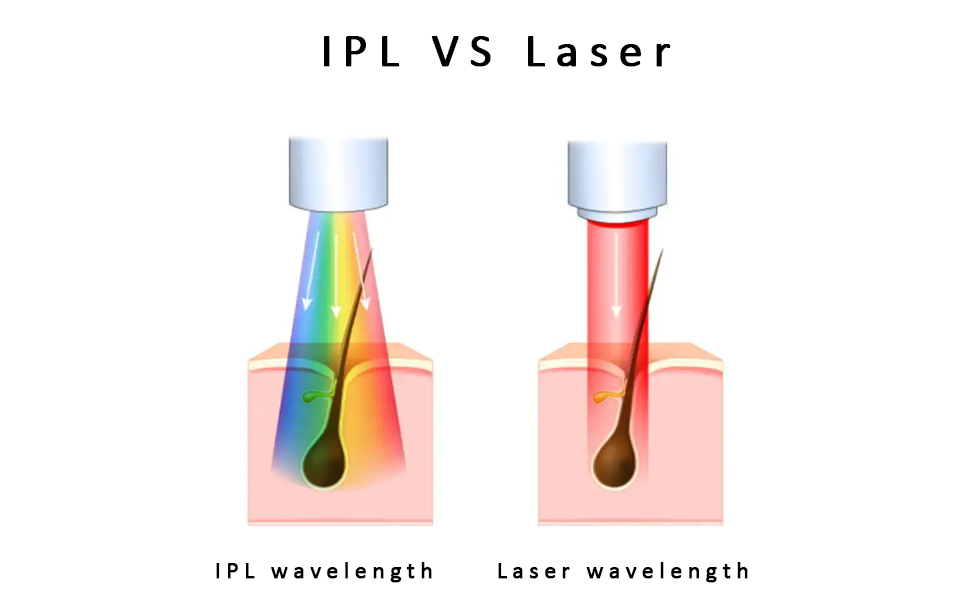
IPL stands for Intense Pulsed Light. The key word is pulsed — it’s not a continuous beam like the light in your treatment room. It fires short, high-energy bursts of broad-spectrum light (roughly 400nm to 1200nm) into the skin. Different wavelengths target different things: shorter waves hit melanin in hair follicles and pigmented spots, longer waves reach hemoglobin in blood vessels.
A laser does something similar, but with one critical difference: a laser emits a single wavelength. That makes lasers more selective — an 808nm diode laser goes after hair follicles and mostly leaves everything else alone. IPL, by contrast, is broadband. That’s both its strength and its limitation.
| Feature | IPL | Diode Laser (808nm) | Nd:YAG (1064nm) |
|---|---|---|---|
| Light type | Broadband (400–1200nm) | Single wavelength | Single wavelength |
| Best for hair removal | Fitzpatrick I–IV, 8–12 sessions | Fitzpatrick I–IV, 6–8 sessions | Fitzpatrick V–VI |
| Pigmentation & sun spots | Excellent, 3–5 sessions | Not indicated | Q-switched mode better |
| Redness & vascular | Good for diffuse redness | Not indicated | Deep vessels |
| Skin rejuvenation | Excellent “lunchtime facial” | Limited | Limited |
| Treatment speed | Fast (large spot size) | Medium | Slower |
| Patient comfort | Moderate (rubber band snap) | Moderate | Higher discomfort |
| Machine cost (FOB China) | $1,500–$8,000 | $2,000–$10,000 | $3,000–$15,000 |
The practical takeaway: if your clinic can only afford one light-based device right now, buy a good IPL. It covers 60–70% of what clients walk in asking for. Add a diode laser later when your IPL is booked solid and you want faster hair removal throughput. Add a fractional CO₂ when you’re ready to charge premium prices for deep resurfacing.
Types of IPL Machines on the Market
Not all IPL devices are built for the same user. There are four broad categories, and buying the wrong type for your practice is the single most common mistake I see.
1. Desktop Professional IPL
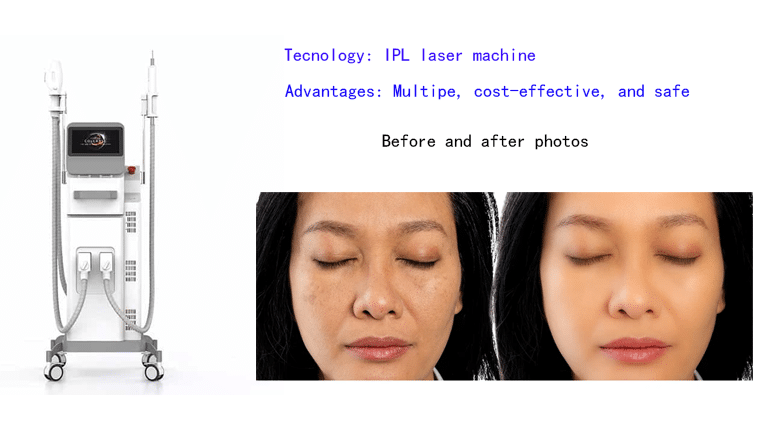
This is the real thing. A console on wheels or a tabletop unit, 500–1,000W of input power, sapphire contact cooling, 5–8 interchangeable cutoff filters, spot sizes from 8×15mm up to 15×50mm, and a flashlamp rated for 100,000–300,000 pulses. If you’re a clinic or med spa charging patients for treatments, this is the minimum. Anything less and you’re compromising either results, safety, or throughput. Price range: $2,500–$8,000 (FOB China).
2. Portable / Handheld Professional IPL
A smaller chassis, lower power (200–400W), fewer filters (typically 3–4), and often a smaller spot size. Still clinically useful for facial treatments in a small salon or a solo aesthetician’s practice, but throughput is lower and you’ll have fewer treatment options. The flashlamp is usually rated for 50,000–100,000 pulses. Price range: $1,000–$3,000.
3. Multi-Function Platforms (IPL + RF + Laser)
These combine IPL with radiofrequency, diode laser, or cavitation in a single console. The appeal is obvious — one machine, multiple revenue streams, less floor space. The trade-off: each individual function is rarely best-in-class. A $5,000 3-in-1 platform won’t match a $5,000 dedicated IPL on photo-rejuvenation results. That said, for a new clinic building a treatment menu from scratch, a multi-function platform can be a smart Phase 1 investment. Price range: $3,000–$8,000.
4. Home-Use IPL Devices
Handheld, low-power (10–50W), small treatment window, no active cooling. These run $80–$500 and are designed for personal use over 8–12 weeks of consistent application. They work — slowly, and only on lighter skin tones — but they are not clinical tools. If you’re reading this guide as a professional, skip this category entirely. Your clients can buy these on Amazon; they’re coming to you for results they can’t get at home.
Key Specs You Must Check Before Buying
This is the section where most buyers glaze over and skip to the price. Don’t. Five minutes understanding these six numbers will save you from buying a machine that looks great on a spec sheet but can’t deliver a treatment your patients will pay for.
| Spec | What to Look For | Why It Matters |
|---|---|---|
| Fluence (Energy Density) | 5–50 J/cm², adjustable in 0.5 J/cm² steps | Too low = no result. Too high = burn. Fine adjustment = you can treat more skin types safely. |
| Cutoff Filters | Minimum 5: 420nm, 515nm, 560nm, 590nm, 640nm+ | Each filter unlocks a treatment category. Fewer than 5 filters means you’re leaving revenue on the table. |
| Pulse Technology | Multi-pulse or OPT (Optimal Pulse Technology) | Splits energy into sub-pulses. Less pain, lower burn risk, safer on darker skin. Standard single-pulse IPL is 15-year-old technology. |
| Spot Size | 15×40mm or larger for body; 8×15mm face tip | A larger spot size can cut treatment time by half. Over a day of back-to-back appointments, that’s 2–3 extra slots. |
| Cooling System | Sapphire contact cooling (TEC), −5°C to +5°C at the tip | Non-negotiable. Air cooling alone is a red flag. Sapphire cooling protects the epidermis and lets you use higher fluences safely. |
| Flashlamp Lifespan | 100,000–300,000 pulses minimum; confirm replacement cost | Replacement costs $500–$2,500. This is your primary consumable. Know the number before you buy. |
Pulse Technology: Why OPT Matters
A standard IPL fires one big energy spike — think of a single hammer blow. OPT (Optimal Pulse Technology) breaks that spike into a series of smaller, controlled pulses with brief cooling gaps in between. The result is a smoother energy profile that heats the target more gradually. For the patient, this means less of that rubber-band-snap sensation. For you, it means you can safely treat Fitzpatrick type IV patients who would be off-limits with a basic single-pulse machine. This isn’t marketing — it’s physics, and any supplier worth dealing with can show you the pulse profile on an oscilloscope.
Filters: Your Revenue Multiplier
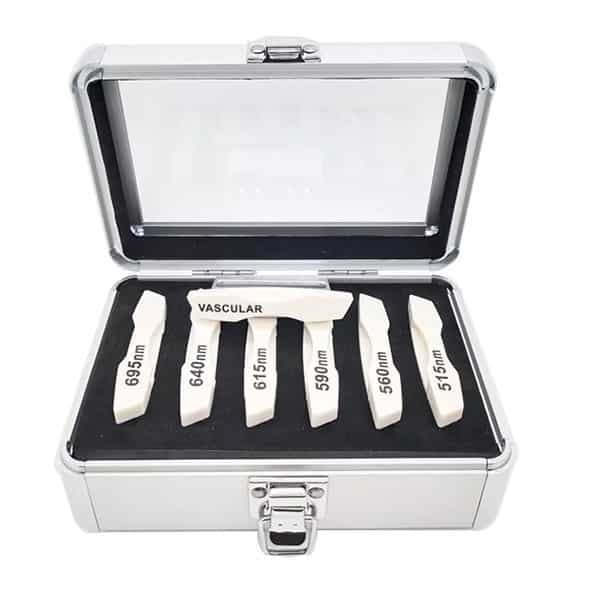
Each cutoff filter blocks shorter wavelengths and lets longer ones through. Change the filter, change the target:
- 420nm (blue light): Acne bacteria. Mild, surface-level inflammatory acne responds well.
- 515–530nm: Superficial pigmentation — freckles, solar lentigo, age spots on fair skin.
- 560–590nm: The “workhorse” range. Vascular lesions, diffuse redness, rosacea, general photo-rejuvenation.
- 640nm+: Hair removal. Longer wavelengths penetrate deeper to reach the hair bulb while sparing the epidermis.
- 690–755nm: Deeper penetration for darker skin types and thicker hair. Lower melanin absorption in the epidermis = safer for type IV.
When a supplier says “5 filters included,” ask which five. If three of them are within 30nm of each other, you’re not getting five distinct revenue streams — you’re getting marketing.
IPL Machine Price Tiers: What You Get at Each Level
IPL pricing follows a predictable structure. Here’s what’s realistic at each tier, based on factory-direct (FOB China) pricing. Add 30–80% if you’re buying through a local distributor.
| Tier | Price (FOB China) | What You Get | Best For |
|---|---|---|---|
| Entry | $1,500–$3,000 | 3–4 filters, single-pulse or basic multi-pulse, 50,000–100,000 shot lamp, semiconductor or basic sapphire cooling, small spot size | Beauty salons adding their first light-based service; solo aestheticians with low patient volume |
| Mid-Range | $3,000–$6,000 | 5–7 filters, OPT or advanced multi-pulse, 150,000–250,000 shot lamp, sapphire TEC cooling, 2–3 spot size options, RFID-authenticated replacement parts | Established clinics and med spas doing 10+ treatments per week; the sweet spot for most buyers |
| Flagship | $6,000–$12,000 | 7–10 filters, OPT with sub-pulse profiling, 250,000–400,000 shot lamp, sapphire TEC with dual-zone cooling, multiple handpieces, built-in skin analyzer integration, advanced safety interlocks | High-volume clinics, training academies, multi-location chains that need identical machines across sites |
A note on the sub-$1,000 “professional” IPL machines you’ll find on Alibaba: the flashlamp is likely used or re-labeled, the housing is generic, and the certifications are either fabricated or borrowed from a different device. If a supplier can’t show you a live video of their factory assembly line with the machine running through a beam profiler test, the $900 unit is a gamble. You might win. You probably won’t.
How Fast Does an IPL Machine Pay for Itself?
Let’s run the numbers on a mid-range machine — the tier where most clinics land.
| Item | Amount | Notes |
|---|---|---|
| Machine cost (one-time, including shipping) | $5,500 | Mid-range IPL, DDP shipping from China |
| Annual consumables (lamp, gel, filters) | ~$800/year | Based on 15 treatments/week; your usage may vary |
| Cost per treatment (consumables only) | ~$1.00 | Gel + fraction of lamp life + filter amortization |
| Average price per IPL facial treatment | $150–$250 | Varies by market — adjust to your local pricing |
| Profit per treatment (at $180 average) | ~$179 | Revenue minus consumable cost |
| Treatments to break even | ~31 treatments | $5,500 ÷ $179 = 31 treatments |
| At 3 treatments/day, 5 days/week | 15/week | A conservative estimate for a single-practitioner clinic |
| Time to full ROI | ~2 weeks | At just three facial treatments per working day |
| Monthly profit after break-even | ~$10,700/month | 15 treatments/week × $179 profit × 4 weeks |
This assumes you’re already getting 3 walk-in IPL clients per day. If you’re starting from zero, budget 1–2 months to build the appointment book. Run a launch promotion — half-price first session, package of 3 for the price of 2 — and you’ll fill slots faster than you think. IPL results photograph well, and before-and-after shots on Instagram bring in more bookings than any ad campaign.
Hidden costs people forget to budget:
- Replacement handpiece or lamp: $500–$2,500 every 2–5 years depending on volume. Ask the supplier for the exact replacement part number and price before you order the machine.
- Conductive gel: ~$200–$500/year at 15 treatments/week. Medical-grade ultrasound gel, not the drugstore stuff.
- Staff training: If the supplier doesn’t include it, budget $500–$1,500 for a 2-day hands-on course. YouTube tutorials are not training.
- Annual calibration: Some manufacturers include first-year calibration in the warranty. If not, budget $300–$800/year to have a tech verify output consistency.
6 Red Flags When Buying an IPL Machine
I’ve talked to enough clinic owners who got burned to know the patterns. Here’s what should make you walk away:
- “FDA Cleared” with no verifiable K-number. Ask for the exact 510(k) number. Type it into the FDA’s Premarket Notification database yourself. If the supplier hedges, stalls, or sends you a certificate image without a number — the claim is fake. Same drill for CE: verify the 4-digit Notified Body number on the EU NANDO database.
- Air cooling only, or cooling system undisclosed. IPL without sapphire contact cooling is a burn lawsuit waiting to happen. The tip of the handpiece should be cold to the touch — 0°C to 5°C — before it contacts the patient’s skin. If the spec sheet says “air cooling” or doesn’t mention cooling at all, move on.
- Flashlamp lifespan under 50,000 pulses with no replacement guarantee. At 15 treatments/week, a 50,000-shot lamp is dead in under a year — and if there’s no replacement path, neither is your machine. Ask: “What is the exact replacement lamp part number? What does it cost? Do you have them in stock right now?”
- Price below $1,000 for a new “professional” machine. At that price, the lamp alone costs more to manufacture than the selling price. Something is wrong — used components, fake certifications, or both. The math doesn’t work any other way.
- Supplier can’t do a live video factory tour. A pre-recorded walkthrough video means nothing — anyone can film one in someone else’s factory. Insist on a real-time video call where they walk the camera through the assembly line, show you the testing station (beam profiler, power meter), and demonstrate a machine firing. If they won’t do it, you’re talking to a trading company, not a manufacturer.
- No after-sales support SLA in writing. “We’ll help you if anything goes wrong” is not a warranty. Get the specific response time commitment: ≤12 hours for remote diagnosis via video call, parts shipped within 48 hours for common wear items, and a clear escalation path if the first-line support person can’t fix the issue. Call their support line on a Friday afternoon before you buy. See what happens.
Certifications That Actually Matter
Everyone slaps logos on a website. Here’s what each one actually means — and how to verify it:
- ISO 13485:2016 — Certifies the manufacturing quality management system, not the product. The factory has documented processes for design, production, inspection, and traceability. Verify the certificate number on the issuing body’s database (TÜV, SGS, BSI, etc.).
- CE Medical (MDR 2017/745, Class IIb) — Required for EU/EEA clinics. The old MDD directive is expired; the certificate must reference MDR 2017/745. The 4-digit Notified Body number next to the CE mark must match a real entry on the NANDO database.
- FDA 510(k) Clearance — Required for US clinics. Most IPL devices are cleared for general dermatological indications, not “hair removal” or “skin rejuvenation” specifically. The K-number must be verifiable on the FDA database.
- IEC 60601-1-2 — Electromagnetic compatibility. Important if you’re running multiple devices (IPL, laser, RF) in the same room. Prevents one machine from interfering with another.
- RoHS & FCC — Hazardous substance compliance and electromagnetic emissions. Table stakes; any legitimate manufacturer has these.
One practical test: ask the supplier to email you PDF copies of all five certificates. Don’t explain why. If they push back, deflect, or send you links instead of PDFs, treat it as a red flag. A real manufacturer has these documents on their server and can email them in five minutes.
Frequently Asked Questions
How many IPL treatments does a patient need to see results?
For hair removal: 6–10 sessions spaced 4–6 weeks apart, because IPL only hits follicles in the active growth phase (anagen). For pigmentation and sun damage: 3–5 sessions, usually 3–4 weeks apart. For general photo-rejuvenation: 3–5 sessions, with maintenance every 3–6 months. Results are cumulative — the second and third sessions usually show the most dramatic improvement.
Is IPL painful?
Most patients describe it as a quick rubber-band snap against the skin — uncomfortable but brief. The sensation is sharper on areas with darker, coarser hair (underarms, bikini line) and milder on the face. Machines with OPT or multi-pulse technology are noticeably more comfortable because the energy is delivered in smaller increments. Sapphire cooling also helps — the cold tip numbs the skin on contact. Topical numbing cream is optional; most patients don’t need it for facial treatments.
Can IPL treat darker skin types?
Fitzpatrick types I–IV: yes, with proper settings. Type V–VI: this is where IPL reaches its limit. The problem: darker skin has more epidermal melanin, which absorbs IPL energy meant for the target (hair or pigment). This risks burns and post-inflammatory hyperpigmentation. For type V–VI patients, an Nd:YAG laser (1064nm) is the safer choice — the longer wavelength largely bypasses epidermal melanin. Some advanced IPL systems with 690nm+ filters and OPT can cautiously treat type V, but only with conservative settings and mandatory test patches. If a significant portion of your patient base has darker skin, consider an Nd:YAG platform instead of — or in addition to — IPL.
What’s the difference between OPT, SHR, and standard IPL?
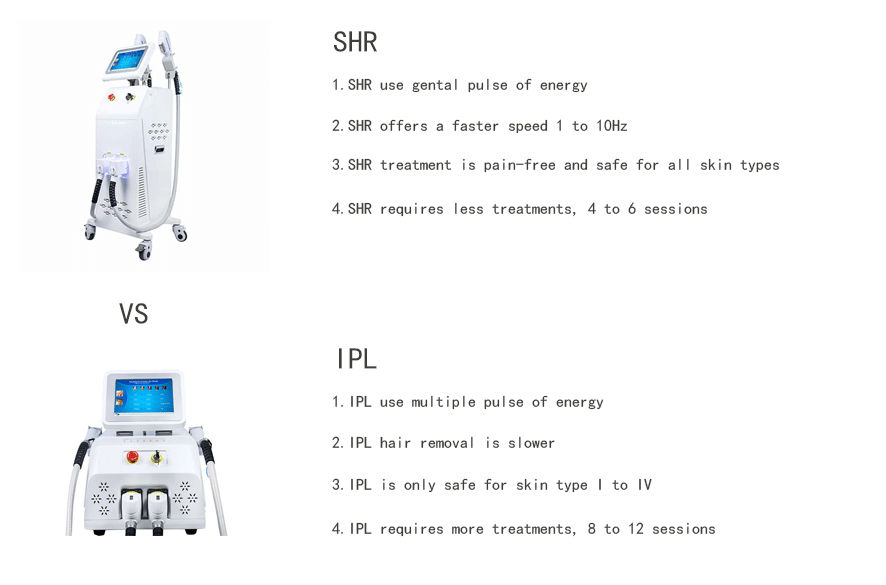
Standard IPL: one big energy pulse. Quick, simple, but higher discomfort and narrower safe skin-type range. OPT (Optimal Pulse Technology): splits energy into a series of sub-pulses with controlled gaps. Smoother energy delivery, less pain, safer on type IV. SHR (Super Hair Removal): uses rapid low-fluence pulses at higher repetition rates, gradually heating the follicle instead of hitting it with a single high-energy spike. SHR is specifically for hair removal; OPT works across all IPL indications. A machine with both OPT and SHR modes gives you maximum flexibility.
Should I buy from a manufacturer or a local distributor?
Factory-direct (from China): 30–50% lower price, direct warranty relationship, but you handle import logistics and there’s no local technician to call. Local distributor: higher price, but they handle shipping, provide local training and repair service, and are accountable under your country’s consumer laws. The pragmatic answer: if you’re buying one machine, find a local distributor with a strong reputation and pay the premium for peace of mind. If you’re buying 3+ machines or are comfortable with international logistics (DDP shipping, spare parts inventory, video-call troubleshooting), go factory-direct. At VIVA, we sell factory-direct with DDP shipping included — the machine arrives at your door, and we provide video training and remote support. You get the factory price without the logistics headache.
How long does an IPL machine last?
The console itself: 7–10 years with proper maintenance. The handpiece and flashlamp: 2–5 years depending on treatment volume. At 15 treatments/week, expect to replace the lamp every 2–3 years for a mid-range machine with a 200,000-shot rating. The cooling system (TEC element) and power supply are the other common failure points — that’s why a 2-year warranty on the console matters. Budget lamp replacement as an operating expense from day one, not a surprise in year three.
Ready to add IPL to your clinic? See VIVA’s IPL Photofacial Machine — 5 filters, OPT multi-pulse technology, sapphire TEC cooling, and 250,000-shot flashlamp. Includes operation video, training manual, certification documentation, and 1-year warranty. Contact us for current pricing and a live video demo.